 |
" a+e June 9, 1999 |
news | a+e | sf
life | extra | sfbg.com |
 |
|
Lightning is his life Greg Leyh works at the Stanford Linear Accelerator by day. By night, he plays with a Tesla coil. By Summer Burkes
As revelers make beelines into nothingness to find respite from sensory overload, bleary eyes that peek out from dust-caked, sleep-deprived, chemically altered bodies can't hardly believe the things they see: A dozen circus performers haphazardly rolling a giant PVC-pipe orb with a chair and strapped-in rider in the center. A dangerously overpopulated, sawed-off And further away, where population, and therefore potential injuries, are thinner, a man in a cobbled-together metal suit with a birdcage on his head tempts fate, standing next to an active Tesla coil, letting the jolts of lightning lick him and fragment into tendrils only a few inches from his face. He holds a hot dog aloft in his right hand, cooking it. Three hundred yards on the other side of the pathway that leads to the 50-foot "Man," another, larger Tesla coil, with no protective fences or warning signs, whines like an angry chain saw for a growing throng, throwing out one and a half million volts of electricity and spitting fire into the dry earth. This Tesla coil's daddy, 37-year-old Brisbane resident Greg Leyh, works by day as a scientist at the Stanford Linear Accelerator. By night, lightning is his life. Electric avenueAfter his long days at one of the most distinguished research centers on the planet, Leyh's love of all things electrical doesn't rest: he runs a nonprofit organization called Lightning on Demand (LOD), a loosely woven collective of odd machine buffs who also make up part of San Francisco's famed Survival Research Laboratories. ("I heard about SRL from a friend in Texas -- he sent me a fifth-generation video tape of one of the old shows," Leyh says. "I just showed up here one rainy night about ten years ago.") Lightning on Demand makes Tesla coils and Lorentz guns -- strictly for the hell of it. Leyh's office sits in a corner of the cramped, perilous warehouse that serves as SRL's headquarters. The building provides almost as much sensory overload as a good night in Black Rock City: cables hang from every available hook and nail, hulking industrial machines and tools jockey for space, mathematical equations hang brainily on the wall, a thin coat of grease covers just about everything, there's a shop cat named Shop Cat, and care must be taken while stepping around contraptions like the One-Ton Walker, the Sound Cannon, the Six-Legged Running Machine, and even a large electronic spider outfitted with microsensors and poetically controlled by a live guinea pig. While giving a tour of the place, Leyh recounts his history: after getting an electrical engineering diploma at the University of Texas at Arlington, rather than jump on the cyberbandwagon, he saw more romance in the analog route. "I decided to go off into 'power systems,' [designing] equipment that has been around forever," Leyh says. "Ancient forms of electricity are more interesting to me because people back then, it seems, were a lot more ingenious. They devised these really clever ways of doing complicated things without computers." Indeed, all of his machines, hulking and postapocalyptic though they may be, are built without the help of zeroes and ones. ALFLeyh has a dream. He's begun a serious search for investors for a project called the Advanced Lightning Facility (ALF), which, if constructed, would be the largest manufactured pair of Tesla coils in the world. (He's already built the largest existing Tesla coil, the 38-foot Electrum Project.) At a cost of $5 million and with a proposed construction time of 22 months, it's no small endeavor. It would be the first machine in history to manufacture nearly full-scale lightning. "The idea just sort of came naturally when I discovered that there's an ultimate limit to how large you can build a Tesla coil," Leyh says. "The point of diminishing returns kicks in once the Tesla coil is about a hundred and twenty feet tall. The only way you can get a longer arc out of that is to build two of them; you get twice as long of an arc. That's about as big as you can get. I was marveling over the fact that the largest theoretical size for the coil is something that you might conceive of building seriously. I sure would like to see it happen, at least in my lifetime. I'm ready to drop everything in my life and just haul off and build this thing." But where does one put a full-scale lightning facility the size of a football field? "Probably in southern Nevada," Leyh says. "It's flat, a lot of cheap land, dry weather, and it's right near Hoover Dam, so there's a lot of cheap electricity. It's one of the few places where the power companies actually said that they wouldn't mind something like this being attached to their grid. They have plenty to spare, so they wouldn't even notice it." And what's the point? "Lightning causes other damage and mayhem as well, other than just hitting people. It hits transmission lines, knocks out big power plants, all sorts of problems. As far as lightning research, I think it has a lot of merit. There's mysterious things about lighting that still haven't been found out. "The peak in lightning research was around 1960, and after that it just petered off. They left a lot of unanswered questions. Like ball lightning -- nobody knows what it is, even still. All sorts of people are trying to race to create ball lightning in the laboratory, and nobody's really succeeded yet. My approach is dumb, brute force: to re-create the original conditions. [I want to make] a real lightning strike, several hundred feet long, with the same amount of current that a real lightning strike has, and make it go out and hit real earth." Juice
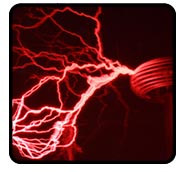
Although he's not yet cooked any hot dogs the hard way himself, Leyh and his LOD buddies did take turns standing inside the Electrum's toroid when they installed and activated it. He's also got some compelling ideas about fusing science and art in hazardous performance pieces with the 17-footer. "I've been wanting to rent one of these shark suits made out of chain mail. It's a good conductor, nice and flexible. I want to put it on under normal clothing, like a black martial arts outfit. I have an old two-edged metal sword, and I wanna go out there and spar with the lightning." So a couple million volts of electricity wouldn't even cause a frisson? "On this one you might start to feel it because the current can get pretty high. It'd have to be a really stout suit." If the Advanced Lightning Facility is ever built, Burning Man revelers would surely take a side trip to see the zany experiments/performances Leyh's planning on concocting there: "I want to fly a helicopter between [the towers]. Lightning would dance all over the blades as they turned. You'd have to use an older helicopter that's fly-by-cable instead of fly-by-electronics, but it'd be just fine. It would mostly hit the blades, because they stick far out, and they'd protect the rest of the helicopter. To sit there and hover in the middle -- such an incredible view -- the whole universe around you would be filled with arcs." A gleeful smile spreads across his face. He isn't afraid in the slightest. "I stand right next to lethal voltages all the time," Leyh says. "I guess it's like standing next to a rushing subway train -- you'll die if you step the wrong way, but you know not to do that." Hunters Point to Hoover DamSunset, and the Hunters Point naval shipyard looks like a ghost town. Far inside the complex, a small group of invitees gathers as Leyh and some friends pull the 17-footer out of the converted barn where it lives. He explains to the awed crowd that he scammed the coil's transformers from a research facility that was going to scrap them; they "never made it to the Dumpster. A lot of my projects are made largely from obtainium." Leyh checks the coil for glitches as his "aesthetician and pyrotechnician" Jon Sarriugarte affixes a metal rod to a nearby shelf rack and passes out fluorescent tubes to the puzzled onlookers. When Leyh fires that bad boy up, it hums like a giant mosquito; seconds later, lightning explodes from the top of the toroid. The fluorescent tubes glow eerily and sympathetically in the night. Leyh and Sarriugarte run the coil repeatedly during the evening, stopping to set up "grounds" and prove various theories. The "Rod of Offering" attracts the otherwise random lightning over to one side of the coil. A Styrofoam block attached to the top of the rod glows from the inside and doesn't melt, demonstrating the theory of Saint Elmo's Fire. Some trick wires planted around the shelving explode like firecrackers. A spray-painted two-by-four proves that metallic paint serves as a conductor. For the show's finale, Leyh pumps the voltage to what seems to be
maximum capacity. The lightning goes absolutely haywire, swirling like
lavender death, making contact with the barn, the ground, a nearby truck,
and even the coil itself. It's a spectacular sight. The sight of two Tesla
coils 10 times the size of this one will be worth a drive to Hoover Dam.
|
 IN THE THICK DARK of night, the flat desert that surrounds
Black Rock City metamorphoses from a limitless expanse of sun-parched
alkali dust into a cold, bleak hinterland where vision is impaired so
greatly that it might as well be the end of the earth. Away from the
crowds that gather during the annual Burning Man festival, a few hundred
feet from the art installations, techno dens, theme camps, and
body-painted hedonists that form the chaotic community, are the stretches
of land where the bars of performance art and technological innovation are
truly raised.
IN THE THICK DARK of night, the flat desert that surrounds
Black Rock City metamorphoses from a limitless expanse of sun-parched
alkali dust into a cold, bleak hinterland where vision is impaired so
greatly that it might as well be the end of the earth. Away from the
crowds that gather during the annual Burning Man festival, a few hundred
feet from the art installations, techno dens, theme camps, and
body-painted hedonists that form the chaotic community, are the stretches
of land where the bars of performance art and technological innovation are
truly raised.
| |
news | a+e | sf
life | extra | sfbg.com |